Question 1
↑ Jump to NavigatorFind the 12th term of a GP with common ratio 2, whose 8th term is 192.
Solution
For a GP,
Given:
So,
Now,
Therefore, the 12th term is 3072.
Answer:t₁₂ = 3072
Complete step-by-step solutions for Class 9 Mathematics Ganita Manjari Chapter 8 Exercise Set 8.3. Covers Geometric Progressions (GP), evaluating nth terms, term position determination, recursive and explicit sequence formulas, bouncing ball distance applications, and Sierpiński square carpet fractal modeling.
A sequence where each term after the first is obtained by multiplying the preceding term by a fixed non-zero number called the common ratio (r).
The initial term is denoted by a, and the ratio between consecutive terms is constant: r = tₙ / tₙ₋₁.
The formula for the nth term of a geometric progression with first term a and common ratio r.
Equate the general term tₙ = arⁿ⁻¹ to the given value and solve for n using equal bases (rⁿ⁻¹ = rᵏ ⟹ n − 1 = k).
An explicit formula gives tₙ directly from n (tₙ = arⁿ⁻¹). A recursive formula links each term to its predecessor (t₁ = a, tₙ = r · tₙ₋₁ for n ≥ 2).
A recursive relation of the form tₙ₊₁ = p · tₙ + q can often be transformed into a GP by substituting uₙ = tₙ − c, where c is a fixed constant.
When a ball drops from initial height H and rebounds each time to ratio r, the drop is travelled once, while every rebound height is travelled twice (upward and downward).
Fractal stages starting at Stage 0: the count of red squares multiplies by 8 each stage (tₙ = 8ⁿ), while the area is multiplied by 8/9 each stage (Aₙ = (8/9)ⁿ), approaching 0 as n increases.
Find the 12th term of a GP with common ratio 2, whose 8th term is 192.
For a GP,
Find the 10th and nth terms of the GP: 5, 25, 125, … .
The GP is:
For a GP,
A sequence is given by the recursive rule t₁ = 2, tₙ₊₁ = 3tₙ − 2, for n ≥ 1. Which term of the sequence is 730?
Subtract 1 from both sides:
Then:
and hence,
Hence, 730 is the 7th term.
Which term of the GP: 2, 6, 18, ... is 4374? Write the explicit formula as well as the recursive formula for the nth term.
The GP is:
Hence, 4374 is the 8th term.
For a GP,
Each term is obtained by multiplying the previous term by 3:
A ball is dropped from a height of 80 metres. After hitting the ground, it bounces back to 60% of the height from which it fell. It continues bouncing in this way — each time rising to 60% of the previous height. (i) What height does the ball reach after the 5th bounce? (ii) What is the total vertical distance the ball has travelled by the time it hits the ground for the 6th time?
The heights reached after successive bounces form a GP.
First bounce:
For a GP,
6.2208 m
The heights reached after the first five bounces are:
48, 28.8, 17.28, 10.368, 6.2208
Their sum is:
48 + 28.8 + 17.28 + 10.368 + 6.2208
The ball first falls through:
80 m
After every bounce, the ball travels upward and then downward through the same height.
301.3376 m
(Note: The initial 80 m fall is the first time the ball hits the ground. Therefore, the 6th ground contact occurs after five bounce heights have been travelled upward and downward.)
Which term of the sequence 2, 2√2, 4, ... is 128?
The sequence is:
2, 2√2, 4, …
This is a GP.
For a GP,
128 is the 13th term.
Fig. 8.12 shows Stages 0 to 3 of the Sierpiński square carpet. Stage 0 of this fractal is a square sheet of paper. To construct Stage 1, each side of the square is trisected and the points of trisection of opposite sides are joined to obtain nine smaller squares. The centre square is then removed and the 8 smaller squares are retained, leaving a square hole in the centre. The same process is repeated on the eight smaller shaded squares to obtain Stage 2 and so on. Look at Fig. 8.12 and try to answer the following questions.
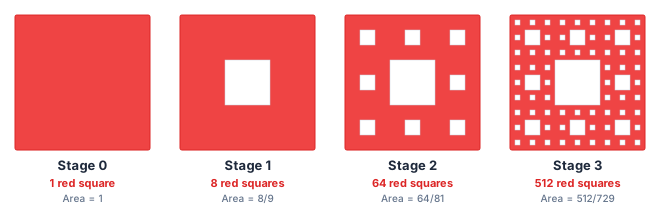
Stages 0 to 3 of the Sierpiński square carpet fractal: at each stage, each red square is trisected into 9 smaller squares and the centre square is removed.
The number of red squares in Stages 0 to 3 is:
Each stage has 8 times as many red squares as the previous stage.
Stage 4:
Stage 5:
The number of red squares is:
Since Stage 0 has 1 red square:
Each stage has 8 times as many red squares as the previous stage.
which matches the pattern.
Starting with:
Each stage has 8 times as many red squares as the previous stage.
At each stage, the square is divided into 9 equal smaller squares and the centre square is removed.
the red area keeps decreasing as the number of stages increases.
Need to practice other sections in Chapter 8?
Return to Chapter 8 (Predicting What Comes Next: Exploring Sequences and Progressions)→