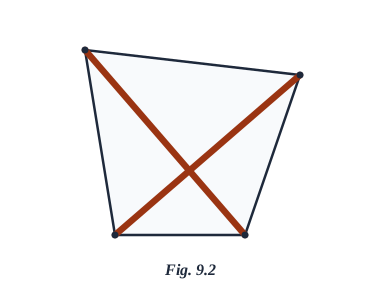
The two sticks are used as the diagonals of the quadrilateral.
(i)
Given property:
If a quadrilateral is of type Q, then it has equal-length diagonals.
(a) Should the two sticks be of equal length?
Yes.
Since every quadrilateral of type Q has equal-length diagonals, the two sticks used as the diagonals should be of equal length.
Yes, the two sticks should be of equal length.
(b) Will it matter how the two sticks are put together?
Yes, it may matter.
The given statement only tells us that a quadrilateral of type Q must have equal diagonals.
It does not say that every quadrilateral with equal diagonals is of type Q.
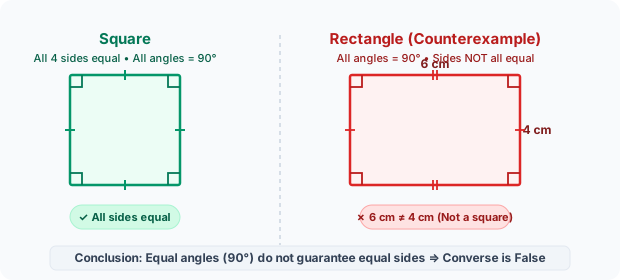
For example, suppose Q represents rectangles. A rectangle has equal diagonals, but simply using two equal sticks does not guarantee that the quadrilateral formed will be a rectangle. Their arrangement can affect the shape.
Therefore,
Yes, the arrangement may matter.
(ii)
Now the property is:
If a quadrilateral has equal diagonals, then it is of type Q.
(a) Should the two sticks be of equal length?
Yes.
The sticks are the diagonals of the quadrilateral.
Therefore, to make the diagonals equal, the two sticks must have equal lengths.
Yes, the two sticks should be of equal length.
(b) Will it matter how the two sticks are put together?
No.
The given statement says that whenever a quadrilateral has equal diagonals, it is of type Q.
So, once the two sticks have equal lengths, the quadrilateral has equal diagonals and therefore must be of type Q.
Thus, the particular arrangement of the two equal sticks does not matter, as long as they form the required quadrilateral.
No, the arrangement does not matter.