What are the x-coordinate and y-coordinate of the point of intersection of the two axes?
The x-axis and y-axis intersect at the origin.
At the origin, both coordinates are zero:
O(0, 0)
Step-by-step solutions for Class 9 Mathematics Ganita Manjari Chapter 1 End-of-Chapter Exercises (Questions 1–16, Page 12–14). Origin of axes, vertical lines and quadrants, quadrilateral RAMP, right-angled triangles, coordinate systems without negative numbers, collinearity, midpoints, trisection of segments, circles on the Cartesian plane, city street grid model, and verifying squares on the coordinate plane.
The horizontal x-axis and vertical y-axis intersect perpendicularly at the origin O(0, 0), where both the x-coordinate (abscissa) and y-coordinate (ordinate) are zero.
Any line parallel to the y-axis is a vertical line. All points on a vertical line have the same constant x-coordinate (x = c), while their y-coordinates can be any real number.
The coordinate axes divide the plane into four quadrants. Signs determine quadrant position: Q I (+, +), Q II (−, +), Q III (−, −), and Q IV (+, −). Points lying on the axes do not belong to any quadrant.
Segments with equal y-coordinates are horizontal and parallel to the x-axis with length |x₂ − x₁|. Segments with equal x-coordinates are vertical and parallel to the y-axis with length |y₂ − y₁|.
Because the Cartesian reference axes are mutually perpendicular, any horizontal line segment is perpendicular to any vertical line segment, meeting at a 90° right angle.
Reflecting a point (x, y) in the x-axis preserves its horizontal coordinate while negating its vertical coordinate: (x, y) → (x, −y).
Connecting a horizontal segment and a vertical segment at a shared vertex forms a right angle (90°). Joining the remaining two endpoints creates the hypotenuse of a right-angled triangle.
In a right-angled triangle on the coordinate grid with perpendicular side lengths a = |Δx| and b = |Δy|, the hypotenuse length c satisfies c² = a² + b², so c = √(a² + b²).
The straight-line distance d between any two points (x₁, y₁) and (x₂, y₂) on the Cartesian plane is given by the distance formula: d = √[(x₂ − x₁)² + (y₂ − y₁)²].
Three points A, B, and C lie on the same straight line if and only if the sum of the distances between two pairs equals the distance between the third pair (e.g., AB + BC = AC).
The midpoint M of a segment connecting S(x₁, y₁) and T(x₂, y₂) has coordinates that are the arithmetic mean of the coordinates of the endpoints: M = ((x₁ + x₂) / 2, (y₁ + y₂) / 2).
Two points P and Q divide segment AB into three equal segments (AP = PQ = QB) when P is the midpoint of AQ and Q is the midpoint of PB.
For a circle centred at the origin O(0, 0) with radius r (where r² = c), any point P(x, y) with OP² = x² + y² lies inside the circle if OP² < r², on the circle if OP² = r², and outside the circle if OP² > r².
When the midpoints D, E, and F of a triangle's sides are given, the midpoint formula gives three linear coordinate equations for each axis (x₂ + x₃ = 2x_D, x₃ + x₁ = 2x_E, x₁ + x₂ = 2x_F). Adding all three equations yields 2(x₁ + x₂ + x₃) = sum, from which each vertex is found by subtracting individual pairwise sums.
In a coordinate street model, an ordered pair (x, y) specifies a unique intersection where a specific vertical line meets a specific horizontal line. The order is essential: (a, b) and (b, a) locate two completely distinct street crossings whenever a ≠ b.
For two circles with centres C₁, C₂ and radii r₁, r₂, the circles intersect at two distinct points if and only if the distance d between their centres satisfies the triangle inequality: |r₁ − r₂| < d < r₁ + r₂.
A quadrilateral ABCD is a square if all four side lengths are equal (AB² = BC² = CD² = DA²) and at least one adjacent pair of sides meets at a 90° right angle, verified using the converse of Pythagoras' theorem (AB² + BC² = AC²). Its area is side².
What are the x-coordinate and y-coordinate of the point of intersection of the two axes?
The x-axis and y-axis intersect at the origin.
At the origin, both coordinates are zero:
O(0, 0)
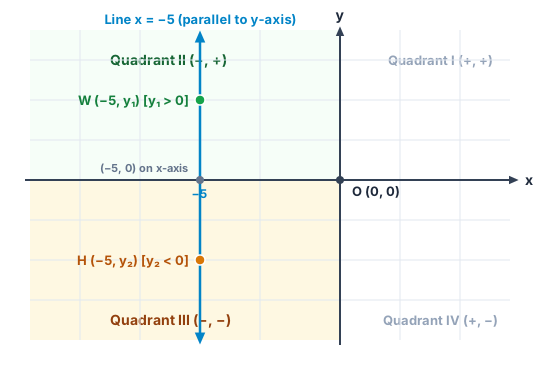
Point W has x-coordinate equal to − 5. Can you predict the coordinates of point H which is on the line through W parallel to the y-axis? Which quadrants can H lie in?
A line through W parallel to the y-axis has constant x-coordinate −5, passing through Quadrant II, the negative x-axis, and Quadrant III.
Coordinates of point H:
Since the line through W is parallel to the y-axis, it is a vertical line.
All points on a vertical line have the same x-coordinate.
where y can be any real number.
Quadrants in which H can lie:
Quadrant II or Quadrant III
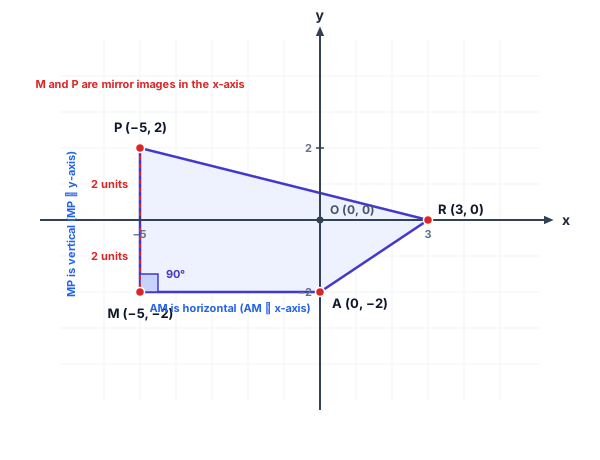
Consider the points R (3, 0), A (0, − 2), M (− 5, − 2) and P (− 5, 2). If they are joined in the same order, predict: (i) Two sides of RAMP that are perpendicular to each other. (ii) One side of RAMP that is parallel to one of the axes. (iii) Two points that are mirror images of each other in one axis. Which axis will this be? Now plot the points and verify your predictions.
Quadrilateral RAMP with horizontal side AM, vertical side MP meeting at 90° at M(-5,-2), and points M and P reflected across the x-axis.
Join the points in the order:
R → A → M → P → R
The four sides of quadrilateral RAMP are RA, AM, MP, and PR.
Consider side AM with endpoints:
A = (0, -2), M = (-5, -2)
Both points have the same y-coordinate (y = −2), so segment AM is horizontal.
Now consider side MP with endpoints:
M = (-5, -2), P = (-5, 2)
Both points have the same x-coordinate (x = −5), so segment MP is vertical.
Since a horizontal line and a vertical line are perpendicular:
AM ⟂ MP
Since A(0, -2) and M(-5, -2) share the same y-coordinate:
AM ∥ x-axis
Also, since M(-5, -2) and P(-5, 2) share the same x-coordinate, MP ∥ y-axis.
AM ∥ x-axis
Consider the vertices:
M = (-5, -2), P = (-5, 2)
Notice that:
Reflection of any point (x, y) across the x-axis gives (x, −y):
(-5, -2) → (-5, 2)
x-axis
Verification by plotting:
Plot the four points on the Cartesian coordinate plane:
R(3, 0), A(0, -2), M(-5, -2), P(-5, 2)
and join them in order to form quadrilateral RAMP.
From the plot:
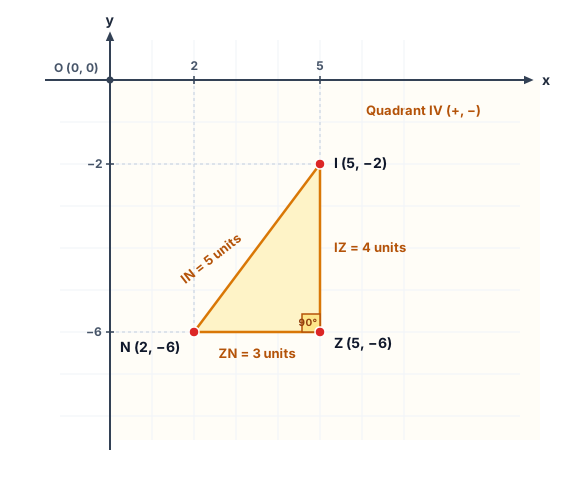
Plot point Z (5, − 6) on the Cartesian plane. Construct a right-angled triangle IZN and find the lengths of the three sides. (Comment: Answers may differ from person to person.)
Right-angled triangle IZN constructed in Quadrant IV with right angle at Z(5, -6), perpendicular sides IZ = 4 units, ZN = 3 units, and hypotenuse IN = 5 units.
Position of point Z:
Point Z has coordinates:
Since its x-coordinate is positive and y-coordinate is negative (+, −), Z lies in Quadrant IV.
Construction of right-angled triangle IZN:
There are many possible choices for points I and N. We choose a convenient construction with the right angle at vertex Z that gives simple whole-number side lengths.
Choose point I vertically above Z:
Choose point N horizontally to the left of Z:
Since I and Z have the same x-coordinate (x = 5), segment IZ is vertical.
Since N and Z have the same y-coordinate (y = −6), segment ZN is horizontal.
A vertical segment and a horizontal segment meet at a right angle:
Therefore, ΔIZN is a right-angled triangle with the right angle at Z.
Length of vertical side IZ:
IZ = |-2 - (-6)| = |-2 + 6| = 4 units
Length of horizontal side ZN:
ZN = |5 - 2| = 3 units
Length of hypotenuse IN:
By the Pythagorean theorem:
Taking the square root:
IZ = 4 units, ZN = 3 units, IN = 5 units
This forms a classic 3–4–5 right-angled triangle.
What would a system of coordinates be like if we did not have negative numbers? Would this system allow us to locate all the points on a 2-D plane?
Understanding a coordinate system without negative numbers:
In the standard Cartesian coordinate system, the coordinate axes extend infinitely in both directions from the origin O(0, 0), using positive and negative real numbers to cover all four quadrants.
If negative numbers did not exist:
Can this system locate all points on a 2-D plane?
No, this system would not allow us to locate all points on a 2-D plane.
Reason:
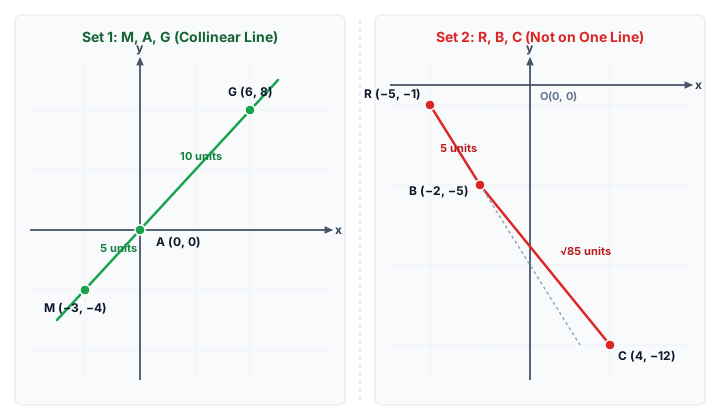
* Are the points M (−3, −4), A (0, 0) and G (6, 8) on the same straight line? Suggest a method to check this without plotting and joining the points.
Suggested Method (The Distance Formula Method):
Three points M, A, and G lie on the same straight line (are collinear) if and only if the sum of the distances between two pairs of points is equal to the distance between the third pair.
We use the Distance Formula derived from the Pythagorean theorem:
d = √[(x₂ − x₁)² + (y₂ − y₁)²]
If MA + AG = MG, then the three points lie on the same straight line, with point A lying between M and G.
Given points:
M = (-3, -4), A = (0, 0), G = (6, 8)
1. Distance MA:
MA = √[(0 − (−3))² + (0 − (−4))²]
MA = √[9 + 16] = √25 = 5 units
2. Distance AG:
AG = √[(6 − 0)² + (8 − 0)²]
AG = √[36 + 64] = √100 = 10 units
3. Distance MG:
MG = √[(6 − (−3))² + (8 − (−4))²]
MG = √[(6 + 3)² + (8 + 4)²]
MG = √[81 + 144] = √225 = 15 units
Checking the collinearity condition:
MA + AG = 5 + 10 = 15 units
Alternative Method (Slope / Ratio of Coordinates):
The ratio of vertical change to horizontal change from M to A is 4/3, and from A to G is 8/6 = 4/3. Since both segments share point A and have the same ratio, they form a single straight line.
* Use your method (from Problem 6) to check if the points R (−5, −1), B (−2, −5) and C (4, −12) are on the same straight line. Now plot both sets of points and check your answers.
Set 1 points M, A, G lie on a single straight line with MA + AG = MG = 15. Set 2 points R, B, C bend at point B because RB + BC ≠ RC (slopes −4/3 ≠ −7/6), so they are not collinear.
Given points:
R = (-5, -1), B = (-2, -5), C = (4, -12)
Using the Distance Formula:
d = √[(x₂ − x₁)² + (y₂ − y₁)²]
1. Distance RB:
RB = √[(−2 − (−5))² + (−5 − (−1))²]
RB = √[(−2 + 5)² + (−5 + 1)²]
RB = √[9 + 16] = √25 = 5 units
2. Distance BC:
BC = √[(4 − (−2))² + (−12 − (−5))²]
BC = √[(4 + 2)² + (−12 + 5)²]
BC = √[36 + 49] = √85 units ≈ 9.22 units
3. Distance RC:
RC = √[(4 − (−5))² + (−12 − (−1))²]
RC = √[(4 + 5)² + (−12 + 1)²]
RC = √[81 + 121] = √202 units ≈ 14.21 units
Checking the collinearity condition:
RB + BC = 5 + √85 ≈ 5 + 9.22 = 14.22 units
Notice that:
(Exact check: (5 + √85)² = 25 + 10√85 + 85 = 110 + 10√85 ≈ 202.196 ≠ 202)
Also, comparing slopes:
Slope of RB = (−5 − (−1)) / (−2 − (−5)) = −4/3
Slope of BC = (−12 − (−5)) / (4 − (−2)) = −7/6
Since −4/3 ≠ −7/6, the directions of segments RB and BC differ.
Plotting both sets of points and checking the answers:
Refer to Fig. 1.11:
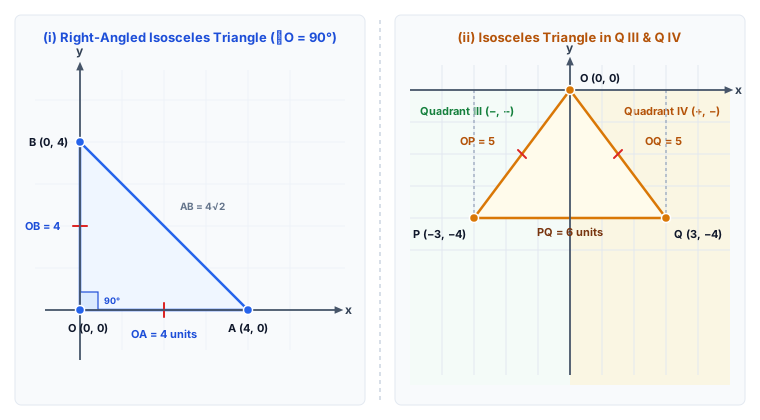
* Using the origin as one vertex, plot the vertices of: (i) A right-angled isosceles triangle. (ii) An isosceles triangle with one vertex in Quadrant III and the other in Quadrant IV.
(i) Left panel: Right-angled isosceles triangle OAB with OA = OB = 4 units and ∠AOB = 90°. (ii) Right panel: Isosceles triangle OPQ with equal sides OP = OQ = 5 units, vertex P(−3, −4) in Quadrant III, and vertex Q(3, −4) in Quadrant IV.
An isosceles right-angled triangle has two perpendicular sides of equal length.
Let the origin O(0, 0) be the vertex containing the right angle (90°).
Choose the second vertex A along the positive x-axis:
Side length OA = |4 − 0| = 4 units.
Choose the third vertex B along the positive y-axis at the same distance:
Side length OB = |4 − 0| = 4 units.
Since the x-axis and y-axis are mutually perpendicular:
And since OA = OB = 4 units, ΔOAB is an isosceles right-angled triangle.
Length of hypotenuse AB:
AB = √[4² + 4²] = √[16 + 16] = √32 = 4√2 units
O(0, 0), A(4, 0), B(0, 4)
(Note: Any non-zero distance a along perpendicular axes yields a valid triangle, such as (a, 0) and (0, a).)
Recall the sign rules for the lower quadrants:
We take origin O(0, 0) as the shared apex vertex, and choose two points P and Q with equal distances from the origin (OP = OQ):
Choose vertex P in Quadrant III:
Distance from origin OP:
OP = √[(−3)² + (−4)²] = √[9 + 16] = √25 = 5 units
Choose vertex Q in Quadrant IV as the reflection of P across the y-axis:
Distance from origin OQ:
OQ = √[3² + (−4)²] = √[9 + 16] = √25 = 5 units
Since OP = OQ = 5 units, triangle OPQ is isosceles.
PQ = |3 − (−3)| = 6 units
Since 5 + 5 = 10 > 6 (triangle inequality holds) and OP = OQ, ΔOPQ is a genuine isosceles triangle with P in Quadrant III and Q in Quadrant IV.
O(0, 0), P(-3, -4), Q(3, -4)
* The following table shows the coordinates of points S, M and T. In each case, state whether M is the midpoint of segment ST. Justify your answer.
| S | M | T | Is M the midpoint of ST? Yes or No | Reason for your answer |
|---|---|---|---|---|
| (-3, 0) | (0, 0) | (3, 0) | ||
| (2, 3) | (3, 4) | (4, 5) | ||
| (0, 0) | (0, 5) | (0, -10) | ||
| (-8, 7) | (0, -2) | (6, -3) |
When M is the mid-point of ST, can you find any connection between the coordinates of M, S and T?
A point M is the midpoint of segment ST when its coordinates are halfway between endpoints S(x₁, y₁) and T(x₂, y₂):
M = ((x_S + x_T)/2, (y_S + y_T)/2)
| S | M | T | Is M the midpoint of ST? | Reason for your answer |
|---|---|---|---|---|
| (-3, 0) | (0, 0) | (3, 0) | Yes | Midpoint = (0, 0) = M |
| (2, 3) | (3, 4) | (4, 5) | Yes | Midpoint = (3, 4) = M |
| (0, 0) | (0, 5) | (0, -10) | No | Midpoint = (0, −5), not M |
| (-8, 7) | (0, -2) | (6, -3) | No | Midpoint = (−1, 2), not M |
For any two points S(x₁, y₁) and T(x₂, y₂), the coordinates of midpoint M are the averages of the coordinates of S and T:
M = ((x₁ + x₂)/2, (y₁ + y₂)/2)
Representative calculation (Row 2):
For S(2, 3) and T(4, 5):
Midpoint = ((2 + 4)/2, (3 + 5)/2)
Since the given coordinates are M(3, 4), which matches the calculated midpoint, M is indeed the midpoint of ST.
The same midpoint calculation is used for all four rows in the table.
When M is the midpoint of segment ST, each coordinate of M is the arithmetic average (mean) of the corresponding coordinates of S and T:
M = ((x_S + x_T)/2, (y_S + y_T)/2)
This fundamental coordinate connection directly leads to Question 10, where it is used to determine an unknown endpoint.
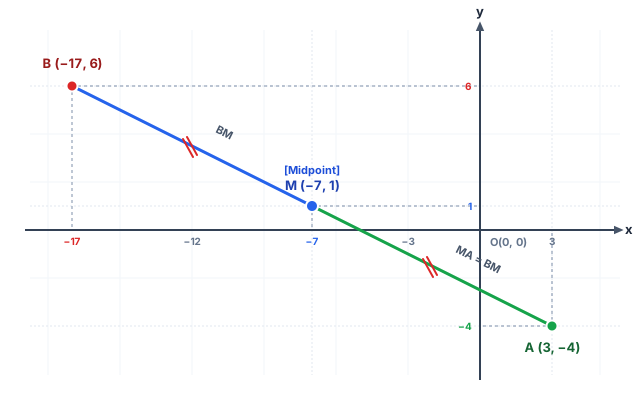
* Use the connection you found to find the coordinates of B given that M (-7, 1) is the midpoint of A (3, -4) and B (x, y).
Line segment AB on the Cartesian coordinate plane with midpoint M(−7, 1) bisecting the segment between A(3, −4) and B(−17, 6).
Using the midpoint relationship:
Since M(-7, 1) is the midpoint of segment AB:
M = ((x_A + x)/2, (y_A + y)/2)
((3 + x)/2, (-4 + y)/2) = (-7, 1)
Equating corresponding coordinates:
For the x-coordinate:
For the y-coordinate:
Verification:
Calculate the midpoint of A(3, -4) and B(-17, 6):
Midpoint = ((3 + (-17))/2, (-4 + 6)/2) = (-14/2, 2/2) = (-7, 1)
This is exactly M(-7, 1), confirming the solution.
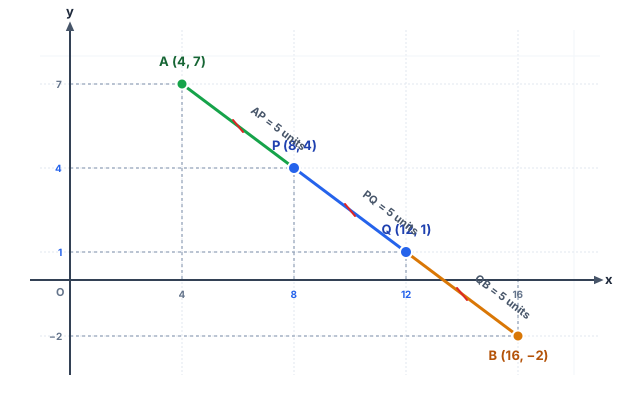
* Let P, Q be points of trisection of AB, with P closer to A, and Q closer to B. Using your knowledge of how to find the coordinates of the midpoint of a segment, how would you find the coordinates of P and Q? Do this for the case when the points are A (4, 7) and B (16, -2).
Segment AB trisected into three equal lengths AP = PQ = QB = 5 units by points P(8, 4) and Q(12, 1), where P is the midpoint of AQ and Q is the midpoint of PB.
Understanding the trisection relationship:
Points P and Q trisect segment AB into three equal parts, with P closer to A and Q closer to B:
Using our knowledge of midpoints:
Given endpoints:
A = (4, 7), B = (16, -2)
Let the coordinates of the trisection points be:
P = (x₁, y₁), Q = (x₂, y₂)
Setting up midpoint equations:
1. Since P is the midpoint of AQ:
x₁ = (4 + x₂)/2, y₁ = (7 + y₂)/2 ... (1)
2. Since Q is the midpoint of PB:
x₂ = (x₁ + 16)/2, y₂ = (y₁ + (-2))/2 ... (2)
From (1), we have x₁ = (4 + x₂)/2.
Substitute this expression for x₁ into equation (2):
x₂ = (((4 + x₂)/2) + 16) / 2
Multiply both sides by 2:
Multiply both sides by 2 again:
Substitute x₂ = 12 into (1) to determine x₁:
x₁ = (4 + 12)/2 = 16/2 = 8
From (1), we have y₁ = (7 + y₂)/2.
Substitute this expression for y₁ into equation (2):
y₂ = (((7 + y₂)/2) - 2) / 2
Multiply both sides by 2:
Multiply both sides by 2 again:
Substitute y₂ = 1 into (1) to determine y₁:
y₁ = (7 + 1)/2 = 8/2 = 4
Coordinates of the trisection points:
P = (8, 4), Q = (12, 1)
Verification using midpoints:
Length verification:
AP = √[(8 − 4)² + (4 − 7)²] = √[16 + 9] = 5 units
PQ = √[(12 − 8)² + (1 − 4)²] = √[16 + 9] = 5 units
QB = √[(16 − 12)² + (−2 − 1)²] = √[16 + 9] = 5 units
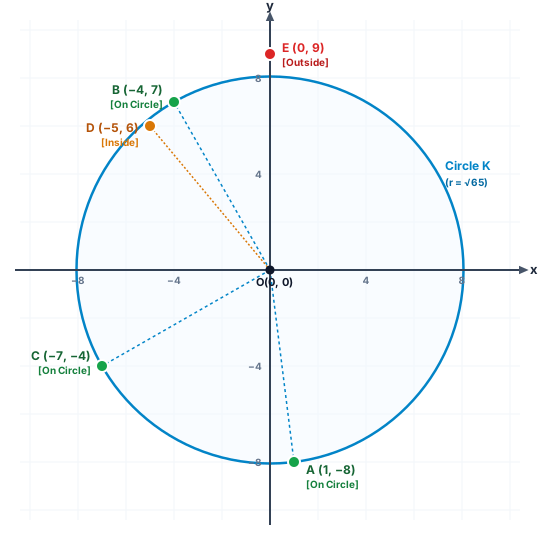
* (i) Given the points A (1, -8), B (-4, 7) and C (-7, -4), show that they lie on a circle K whose center is the origin O (0, 0). What is the radius of circle K? (ii) Given the points D (-5, 6) and E (0, 9), check whether D and E lie within the circle, on the circle, or outside the circle K.
Circle K with centre O(0, 0) and radius r = √65 units. Points A, B, and C lie on the circumference (distance = √65), D lies inside the circle (OD² = 61 < 65), and E lies outside the circle (OE² = 81 > 65).
A circle is the set of all points in a plane equidistant from a fixed centre point.
Here, the centre of circle K is the origin O(0, 0).
The squared distance of any point (x, y) from the origin is:
For point A(1, -8):
For point B(-4, 7):
For point C(-7, -4):
Taking the square root:
OA = OB = OC = √65 units
Since points A, B, and C are all at the exact same distance from the centre O(0, 0), they all lie on the same circle K.
From part (i), the squared radius of circle K is:
A point (x, y) lies:
For point D(-5, 6):
61 < 65 ⟹ OD² < r² ⟹ OD < r
For point E(0, 9):
81 > 65 ⟹ OE² > r² ⟹ OE > r
Conclusion:
Point D lies within the circle, and point E lies outside circle K.
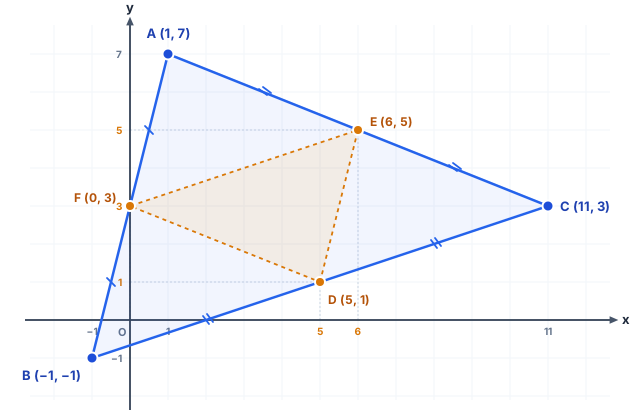
* The midpoints of the sides of triangle ABC are the points D, E, and F. Given that the coordinates of D, E, and F are (5, 1), (6, 5), and (0, 3), respectively, find the coordinates of A, B and C.
Triangle ABC on the Cartesian plane with vertices A(1, 7), B(−1, −1), and C(11, 3). Points D(5, 1), E(6, 5), and F(0, 3) are the midpoints of sides BC, CA, and AB respectively, connected by the dashed medial triangle DEF.
Let the coordinates of the vertices of triangle ABC be:
Given coordinates of the midpoints:
where:
Using the midpoint formula:
Since D is the midpoint of BC:
((x₂ + x₃)/2, (y₂ + y₃)/2) = (5, 1)
Since E is the midpoint of CA:
((x₃ + x₁)/2, (y₃ + y₁)/2) = (6, 5)
Since F is the midpoint of AB:
((x₁ + x₂)/2, (y₁ + y₂)/2) = (0, 3)
(x₂ + x₃) + (x₃ + x₁) + (x₁ + x₂) = 10 + 12 + 0
x₁ + x₂ + x₃ = 11 ... (4)
Now, solve for each x-coordinate using equation (4):
x₁ = 11 − (x₂ + x₃) = 11 − 10 = 1
x₂ = 11 − (x₁ + x₃) = 11 − 12 = −1
x₃ = 11 − (x₁ + x₂) = 11 − 0 = 11
(y₂ + y₃) + (y₃ + y₁) + (y₁ + y₂) = 2 + 10 + 6
y₁ + y₂ + y₃ = 9 ... (5)
Now, solve for each y-coordinate using equation (5):
y₁ = 9 − (y₂ + y₃) = 9 − 2 = 7
y₂ = 9 − (y₃ + y₁) = 9 − 10 = −1
y₃ = 9 − (y₁ + y₂) = 9 − 6 = 3
Checking the midpoints of the calculated vertices:
A = (1, 7), B = (−1, −1), C = (11, 3)
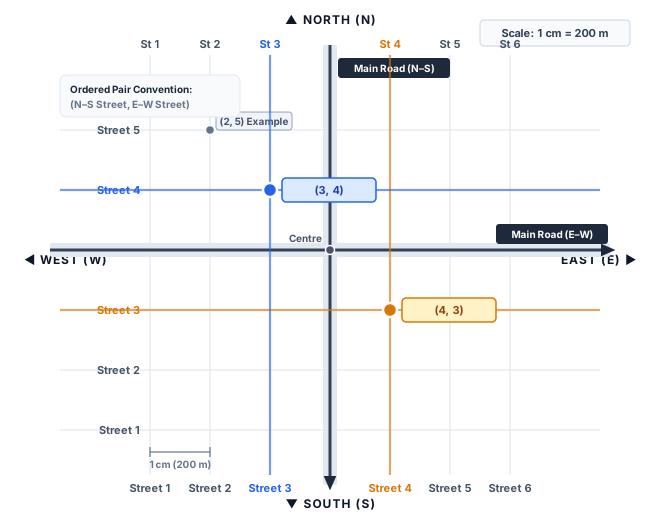
A city has two main roads which cross each other at the centre of the city. These two roads are along the North–South (N–S) direction and East–West (E–W) direction. All the other streets of the city run parallel to these roads and are 200 m apart. There are 10 streets in each direction. (i) Using 1 cm = 200 m, draw a model of the city in your notebook. Represent the roads/streets by single lines. (ii) There are street intersections in the model. Each street intersection is formed by two streets—one running in the N–S direction and another in the E–W direction. Each street intersection is referred to in the following manner: If the second street running in the N–S direction and 5th street in the E–W direction meet at some crossing, then we call this street intersection (2, 5). Using this convention, find: (a) how many street intersections can be referred to as (4, 3). (b) how many street intersections can be referred to as (3, 4).
Model of the city with two main roads crossing at the centre and parallel streets spaced 1 cm (= 200 m) apart. N–S Street 4 and E–W Street 3 meet at unique intersection (4, 3), while N–S Street 3 and E–W Street 4 meet at unique intersection (3, 4).
Given scale:
Since adjacent streets are 200 m apart in reality, they should be drawn:
1 cm apart
in the model.
To construct the model:
According to the convention given in the problem, an intersection is written as:
(N–S street number, E–W street number)
The ordered pair (4, 3) refers to:
Since two straight lines that are perpendicular intersect at exactly one unique point:
These two particular streets meet at only one point.
street intersection can be referred to as (4, 3).
The ordered pair (3, 4) refers to:
Again, these two particular straight lines intersect at exactly one unique point.
street intersection can be referred to as (3, 4).
Key idea:
The order of the numbers in an ordered pair specifies which street runs N–S and which runs E–W, identifying two completely different crossings.
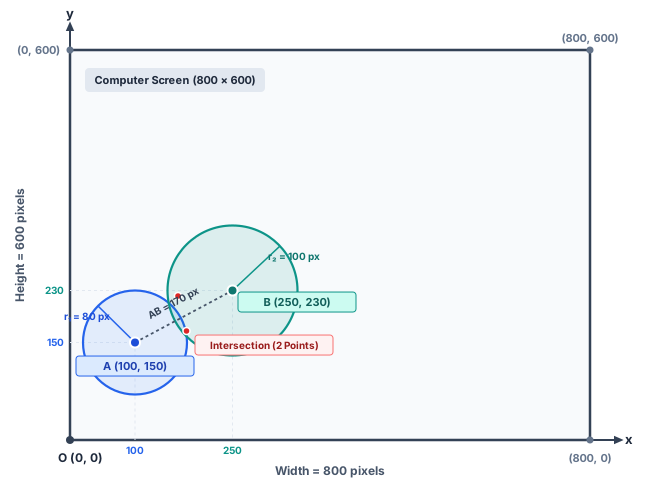
A computer graphics program displays images on a rectangular screen whose coordinate system has the origin at the bottom-left corner. The screen is 800 pixels wide and 600 pixels high. A circular icon of radius 80 pixels is drawn with its centre at the point A (100, 150). Another circular icon of radius 100 pixels is drawn with its centre at the point B (250, 230). Determine: (i) whether any part of either circle lies outside the screen. (ii) whether the two circles intersect each other.
Computer screen extending over 0 ≤ x ≤ 800 and 0 ≤ y ≤ 600. Circle A (centre A(100, 150), radius 80 px) and Circle B (centre B(250, 230), radius 100 px) both lie entirely within the screen boundaries. Since the distance between centres AB = 170 px satisfies |80 − 100| < 170 < 80 + 100, the two circles intersect at two points.
The rectangular screen has its origin (0, 0) at the bottom-left corner.
Given screen dimensions:
For any circle with centre (x, y) and radius r, the circle spans:
x − r to x + r
y − r to y + r
to
to
Comparing with the screen boundaries:
All these values lie completely within the screen boundaries [0, 800] and [0, 600].
to
to
Comparing with the screen boundaries:
These values also lie completely within the screen boundaries.
No part of either circle lies outside the screen.
First find the distance between their centres A(100, 150) and B(250, 230):
AB = √[(250 − 100)² + (230 − 150)²]
The radii of the two circles are:
For two circles to intersect at two distinct points, the distance between their centres must satisfy the triangle inequality:
|r₁ − r₂| < AB < r₁ + r₂
Here,
|r₁ − r₂| = |80 − 100| = 20
r₁ + r₂ = 80 + 100 = 180
Comparing the values:
Since 20 < 170 < 180 is strictly satisfied, the two circles intersect each other at two distinct points.
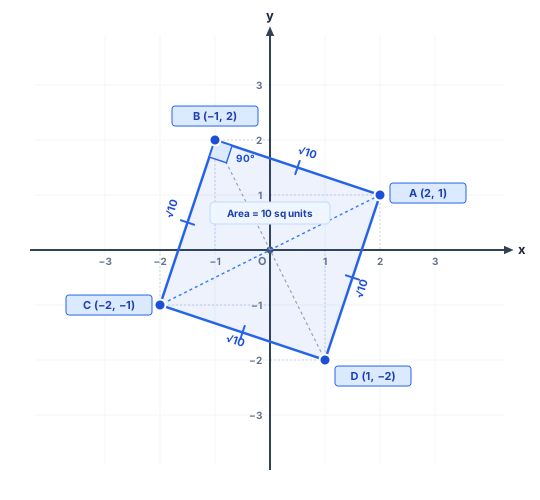
Plot the points A (2, 1), B (−1, 2), C (−2, −1), and D (1, −2) in the coordinate plane. Is ABCD a square? Can you explain why? What is the area of this square?
Square ABCD on the coordinate plane. All four sides have equal length AB = BC = CD = DA = √10 units. Triangle ABC satisfies AB² + BC² = AC² (10 + 10 = 20), proving ∠ABC = 90°. Thus ABCD is a square with Area = side² = 10 square units.
Given coordinates of the four points:
First, plot the four points on the Cartesian coordinate plane and join them in order to form quadrilateral ABCD.
We compare the squares of the side lengths using the distance formula, which avoids unnecessary square-root calculations:
AB² = (−1 − 2)² + (2 − 1)²
BC² = (−2 − (−1))² + (−1 − 2)²
CD² = (1 − (−2))² + (−2 − (−1))²
DA² = (2 − 1)² + (1 − (−2))²
AB² = BC² = CD² = DA² = 10
Taking square roots,
AB = BC = CD = DA = √10 units
We already know:
Now calculate the square of diagonal AC:
AC² = (−2 − 2)² + (−1 − 1)²
Checking the Pythagorean relation:
AB² + BC² = 10 + 10 = 20 = AC²
Since AB² + BC² = AC², by the converse of the Pythagorean theorem:
ABCD is a square.
Since the side length is √10 units (and AB² = 10):
ABCD is a square and its area is 10 square units.
Need to practice other sections in Chapter 1?
Return to Chapter 1 (Orienting Yourself: The Use of Coordinates)→