Class 9 Ganita ManjariClass 9 Maths Solutions | 2026–27
Chapter 1: Orienting Yourself: The Use of CoordinatesPage 8All 4 Questions on This Page

Class 9 Maths Chapter 1 Exercise Set 1.2 Solutions

Step-by-step solutions for Class 9 Mathematics Ganita Manjari Chapter 1 Exercise Set 1.2 (Questions 1–4, Page 8). Plotting a rectangular study table, calculating 2-D floor dimensions, door clearance analysis, bathroom fixture placements, and dining room coordinate geometry.

💡 Quick navigation: Tap any question number in the bar below to jump straight to that question and its step-by-step solution.← Chapter Overview
Jump:

Key Concepts for Exercise Set 1.2

Jump to Question 1
1

Two-Dimensional Coordinate Map (Top-View Floor Plan)

A 2-D coordinate plane maps positions on a flat floor using horizontal and vertical axes (x and y). Dimensions along the plane (length and width) can be measured using coordinates, but height above the floor is not represented in a 2-D map.

Floor Position: (x, y)
2

Determining Missing Vertices & Coordinate Representation of Rectangles

Opposite sides of a rectangle are parallel and equal in length. For sides parallel to coordinate axes, pairs of adjacent vertices share either the same x-coordinate or the same y-coordinate.

Corners: (x₁, y₁), (x₂, y₁), (x₂, y₂), (x₁, y₂)
3

Horizontal and Vertical Distances

For points sharing the same y-coordinate, the distance is the horizontal length |x₂ − x₁|. For points sharing the same x-coordinate, the distance is the vertical width |y₂ − y₁|.

Length = |x₂ − x₁| | Width = |y₂ − y₁|
4

Reading Coordinates from a Grid & Negative Coordinates

Points to the left of the y-axis have negative x-coordinates (x < 0), and points below the x-axis have negative y-coordinates (y < 0).

Left: (−x, y) | Below: (x, −y)
5

Centre / Midpoint of a Rectangle

The centre of a rectangle aligned with the coordinate axes is the midpoint of its horizontal and vertical boundaries, obtained by averaging the corner coordinates.

Centre = ((x₁ + x₂)/2, (y₁ + y₂)/2)
6

Placing Shapes Using Coordinates

To place a rectangular space of given dimensions, specify boundary coordinates that satisfy the required width and length (|Δx| = length, |Δy| = width) while ensuring it stays inside the boundary and does not overlap existing fixtures.

Length = |Δx| | Width = |Δy|
7

Distance Formula Between Two Points

The straight-line distance d between any two points (x₁, y₁) and (x₂, y₂) on the Cartesian coordinate plane is calculated using the distance formula derived from the Pythagorean theorem.

d = √[(x₂ − x₁)² + (y₂ − y₁)²]
8

Door Rotation & Swing Arc

When a hinged door opens, its outer edge sweeps out a circular arc centered at the hinge. The radius of this circle equals the width of the door.

Swing Radius R = Door Width = |y₂ − y₁|

Place Reiaan’s rectangular study table with three of its feet at the points (8, 9), (11, 9) and (11, 7). (i) Where will the fourth foot of the table be? (ii) Is this a good spot for the table? (iii) What is the width of the table? The length? Can you make out the height of the table?
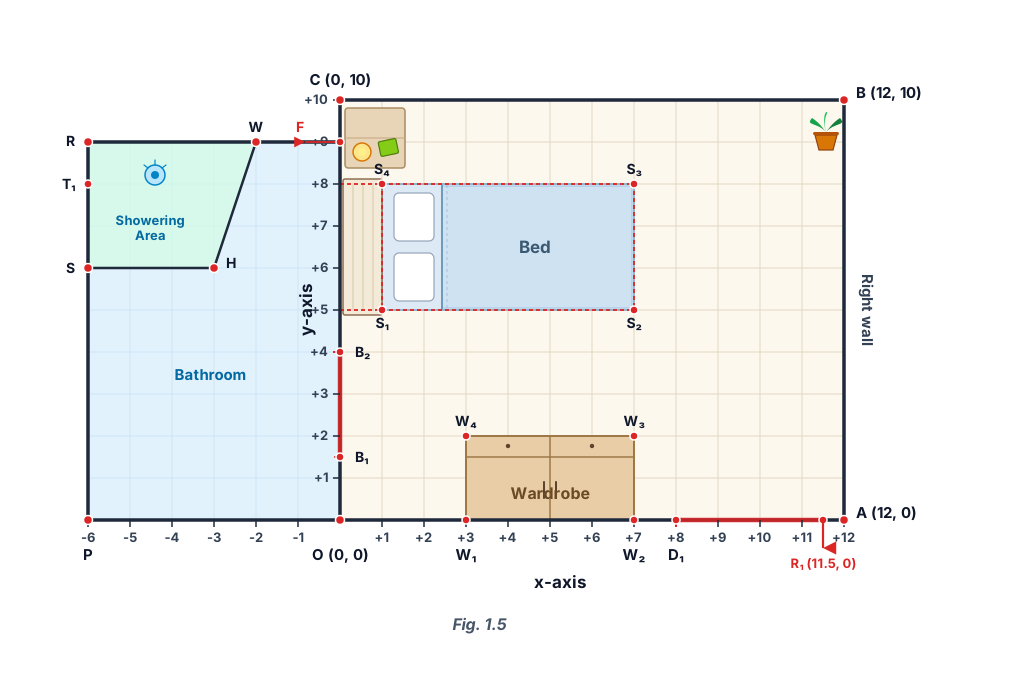
Fig. 1.5: Floor Plan of Reiaan's Bedroom and Attached BathroomFig. 1.5
Fig. 1.5: Floor plan showing Reiaan's bedroom with bed and wardrobe, and attached bathroom with showering area on the Cartesian coordinate plane

Fig. 1.5: Reiaan's room and attached bathroom laid out on the Cartesian coordinate plane with origin O(0, 0).

Solution
(i) Fourth foot of the rectangular study table:

The three given points are:

(8, 9), (11, 9), (11, 7)

Since the study table is rectangular:

•(8, 9) and (11, 9) share the same y-coordinate (y = 9), forming a horizontal side of length 11 − 8 = 3 units.
•(11, 9) and (11, 7) share the same x-coordinate (x = 11), forming a vertical side of width 9 − 7 = 2 units.
Therefore, the fourth foot must have the same x-coordinate as (8, 9) and the same y-coordinate as (11, 7):
x = 8, y = 7
Hence, the fourth foot of the table will be at:

(8, 7)

(ii) Suitability of the table position:

From Fig. 1.5, the four feet of the table are at:

(8, 9), (11, 9), (11, 7), (8, 7)

Looking at the room layout in Fig. 1.5:

•The bed occupies the region from x = 1 to 7 and y = 5 to 8.
•The wardrobe occupies the region from x = 3 to 7 and y = 0 to 2.
•The study table at x = 8 to 11 and y = 7 to 9 lies entirely in the open top-right area of the bedroom.

It does not overlap with the bed, wardrobe, or any doorway.

Therefore, yes, it appears to be a good spot for the table.
(iii) Width, length, and height of the table:

The vertices of the table are (8, 9), (11, 9), (11, 7), and (8, 7).

Width of the table:

The shorter side is vertical, joining (11, 9) and (11, 7):

Width = |9 − 7| = 2 units

Since 1 unit represents 1 ft:

Width = 2 ft

Length of the table:

The longer side is horizontal, joining (8, 9) and (11, 9):

Length = |11 − 8| = 3 units
Length = 3 ft
Height of the table:

Can you make out the height of the table?

No, we cannot determine the height of the table from this map.

Reason:

Fig. 1.5 is a two-dimensional (2-D) top-view floor plan. The x-axis and y-axis show positions and horizontal dimensions on the floor. The height of the table is a vertical measurement above the floor (perpendicular to the floor plane), which is not represented in this 2-D coordinate map.
Therefore, the height of the table cannot be determined from Fig. 1.5.
Answer:(i) (8, 7) | (ii) Yes, it appears to be a good spot for the table | (iii) Width = 2 ft (2 units), Length = 3 ft (3 units); height cannot be determined from the 2-D floor plan

If the bathroom door has a hinge at B₁ and opens into the bedroom, will it hit the wardrobe? Are there any changes you would suggest if the door is made wider?

Solution

Door dimensions and swing path:

From Fig. 1.5:

B₁ = (0, 1.5)

and

B₂ = (0, 4)
Therefore, the length of the bathroom door is:
4 − 1.5 = 2.5 units

When the door opens, it rotates about the hinge B₁(0, 1.5).

Therefore, the outer end of the door moves along a circular arc whose radius is:
Radius = 2.5 units

Checking clearance with the wardrobe:

From Fig. 1.5, the wardrobe is located in the region x = 3 to 7 and y = 0 to 2.

The corner of the wardrobe closest to hinge B₁(0, 1.5) is W₄(3, 2).

The straight-line distance from hinge B₁ to corner W₄ is:

Distance = √[(3 − 0)² + (2 − 1.5)²] = √(9 + 0.25) = √9.25 ≈ 3.04 units

Since the door rotation radius (2.5 units) is strictly less than the distance to the wardrobe (3.04 units), and the door only extends up to x = 2.5 horizontally while the wardrobe starts at x = 3:

2.5 < 3.04

the door clears the wardrobe with about 0.54 units to spare.

Therefore, the bathroom door will not hit the wardrobe.

Suggested changes if the door is made wider:

A wider door would increase the radius of the circular swing arc.

If the door width exceeds 3.04 units (such as a standard 3.5 ft door), its outer edge would hit the wardrobe at corner W₄.

To prevent this, suitable changes would be:

•Move the wardrobe farther away to the right (e.g., starting at x = 4 or x = 5).
•Change the hinge position to B₂(0, 4) so the door swings upward into the room away from the wardrobe.
•Have the door open inward into the bathroom, or use a sliding door.
Therefore, if the door is widened, the wardrobe may need to be moved farther away or the door-opening arrangement changed.
Answer:The bathroom door will not hit the wardrobe (swing radius 2.5 units < distance to wardrobe corner 3.04 units). If the door is widened, the wardrobe should be moved farther away or the hinge position/opening direction changed.

Look at Reiaan's bathroom. (i) What are the coordinates of the four corners O, F, R, and P of the bathroom? (ii) What is the shape of the showering area SHWR in Reiaan's bathroom? Write the coordinates of the four corners. (iii) Mark off a 3 ft × 2 ft space for the washbasin and a 2 ft × 3 ft space for the toilet. Write the coordinates of the corners of these spaces.

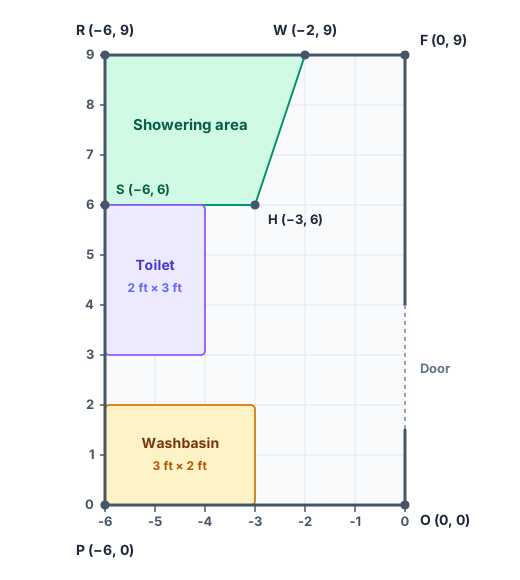
Reiaan's Bathroom LayoutFig. 1.6
Layout of Reiaan's bathroom showing corners O, F, R, P, showering area SHWR, washbasin, and toilet on the coordinate grid

Layout of Reiaan's bathroom showing corners O, F, R, P, showering area SHWR, and marked spaces for the washbasin and toilet.

Solution
(i) Coordinates of corners O, F, R, and P:

From the coordinate grid:

O = (0, 0)
P = (-6, 0)
R = (-6, 9)
F = (0, 9)
Therefore, the coordinates of the four corners in the requested order are:

O = (0, 0), F = (0, 9), R = (-6, 9), P = (-6, 0)

(ii) Shape and coordinates of the showering area SHWR:

From the coordinate grid, the coordinates of the showering area are:

S = (-6, 6)
H = (-3, 6)
W = (-2, 9)
R = (-6, 9)

Examining the sides of quadrilateral SHWR:

•Side SH lies along the horizontal line y = 6.
•Side RW lies along the horizontal line y = 9.

Since both sides are horizontal, SH and RW are parallel (SH || RW).

•Side SR lies along the vertical line x = -6, so it is perpendicular to both horizontal sides SH and RW.

A quadrilateral with one pair of opposite sides parallel is a trapezium. Since side SR is perpendicular to the parallel sides, SHWR is specifically a right-angled trapezium.

Hence, SHWR is a right-angled trapezium.

Its four corners are:

S = (-6, 6), H = (-3, 6), W = (-2, 9), R = (-6, 9)

(iii) Placement of the washbasin and toilet spaces:

The scale of the grid is:

1 unit = 1 ft
Therefore:
•3 ft × 2 ft = 3 units × 2 units
•2 ft × 3 ft = 2 units × 3 units
Note
There can be more than one correct placement. We give one suitable placement below.

Placement of Washbasin (3 ft × 2 ft):

Place the 3 ft × 2 ft washbasin space at the bottom-left part of the bathroom.

Take its four corners as:

(-6, 0), (-3, 0), (-3, 2), (-6, 2)

Verification:

Horizontal length = |-3 - (-6)| = 3 ft

Vertical width = |2 - 0| = 2 ft

Therefore, it is a 3 ft × 2 ft space.

Placement of Toilet (2 ft × 3 ft):

Place the 2 ft × 3 ft toilet space along the left wall above the washbasin.

Take its four corners as:

(-6, 3), (-4, 3), (-4, 6), (-6, 6)

Verification:

Horizontal width = |-4 - (-6)| = 2 ft

Vertical length = |6 - 3| = 3 ft

Therefore, it is a 2 ft × 3 ft space.

The washbasin occupies y = 0 to 2 and the toilet occupies y = 3 to 6. The two spaces do not overlap, leave clear access to the doorway at x = 0, and remain entirely within the bathroom boundary.

Therefore, the coordinates of the corners of these spaces are:

Washbasin: (-6, 0), (-3, 0), (-3, 2), (-6, 2)

Toilet: (-6, 3), (-4, 3), (-4, 6), (-6, 6)

Note
Other placements are also possible, provided the spaces have the required dimensions and are suitably placed inside the bathroom.
Answer:(i) O = (0, 0), F = (0, 9), R = (-6, 9), P = (-6, 0) | (ii) SHWR is a right-angled trapezium; S = (-6, 6), H = (-3, 6), W = (-2, 9), R = (-6, 9) | (iii) Washbasin: (-6, 0), (-3, 0), (-3, 2), (-6, 2); Toilet: (-6, 3), (-4, 3), (-4, 6), (-6, 6)

Other rooms in the house: (i) Reiaan's room door leads from the dining room which has the length 18 ft and width 15 ft. The length of the dining room extends from point P to point A. Sketch the dining room and mark the coordinates of its corners. (ii) Place a rectangular 5 ft × 3 ft dining table precisely in the centre of the dining room. Write down the coordinates of the feet of the table.

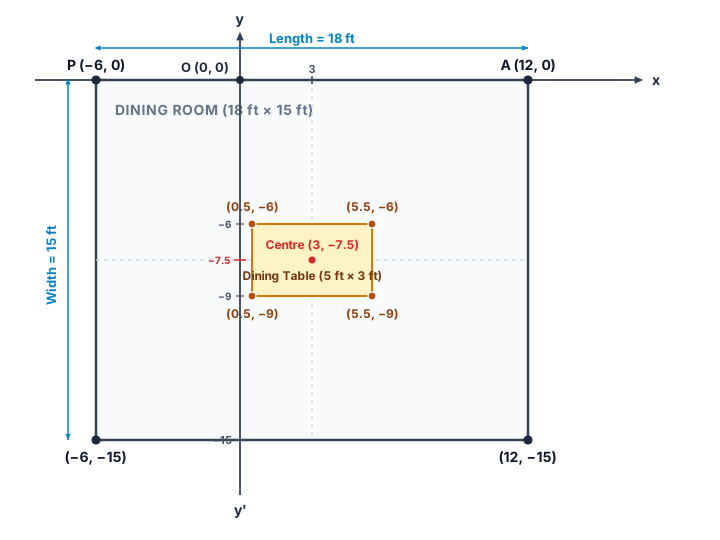
Dining Room and Centred Dining Table LayoutFig. 1.7
Sketch of the dining room extending from P(-6,0) to A(12,0) with corners at (12,-15) and (-6,-15), and a 5 ft × 3 ft dining table centred at (3,-7.5)

Layout of the 18 ft × 15 ft dining room extending below the x-axis, with a 5 ft × 3 ft dining table placed precisely at the centre (3, -7.5).

Solution
(i) Sketch of the dining room and coordinates of its corners:

From the figure:

P = (-6, 0)
A = (12, 0)

Checking the length of the dining room along segment PA:

PA = 12 - (-6) = 18 ft

which agrees with the given length of 18 ft.

Since Reiaan's bedroom lies above the x-axis (y ≥ 0) and the room door opens from the dining room into the bedroom, the dining room extends 15 ft downward from the x-axis (into the region y ≤ 0).

Therefore, the y-coordinate of the bottom wall is:
0 - 15 = -15

The lower corners directly below A(12, 0) and P(-6, 0) are:

(12, -15) and (-6, -15)

Hence, the four corners of the dining room are:

P = (-6, 0), A = (12, 0), (12, -15), (-6, -15)

(ii) Coordinates of the feet of the centred dining table:

First find the centre of the dining room:

x-coordinate of centre:

-6 + 122 = 62 = 3

y-coordinate of centre:

(0 + (-15))/2 = -152 = -7.5
Therefore, the centre of the dining room is:

(3, -7.5)

Now, place the 5 ft × 3 ft rectangular dining table precisely at this centre.

Taking the 5 ft side of the table parallel to the x-axis (horizontal) and the 3 ft side parallel to the y-axis (vertical):

Half of the length (5 ft):

52 = 2.5 ft
Therefore, the x-coordinates of the feet are:

3 - 2.5 = 0.5 and 3 + 2.5 = 5.5

Half of the width (3 ft):

32 = 1.5 ft
Therefore, the y-coordinates of the feet are:

-7.5 - 1.5 = -9 and -7.5 + 1.5 = -6

Hence, one valid placement of the four feet of the table is:

(0.5, -9), (5.5, -9), (5.5, -6), (0.5, -6)

Verification of centre:

((0.5 + 5.5)/2, (-9 + (-6))/2) = (6/2, -15/2) = (3, -7.5)

which is exactly the centre of the dining room.

Note
If the table is oriented with its 3 ft side parallel to the x-axis and 5 ft side parallel to the y-axis, the feet would be at (1.5, -10), (4.5, -10), (4.5, -5), and (1.5, -5). Both orientations are geometrically valid.
Answer:(i) P = (-6, 0), A = (12, 0), (12, -15), (-6, -15) | (ii) Table feet: (0.5, -9), (5.5, -9), (5.5, -6), (0.5, -6) [Centre: (3, -7.5)]

Need to practice other sections in Chapter 1?

Return to Chapter 1 (Orienting Yourself: The Use of Coordinates)→