Class 9 Ganita ManjariClass 9 Maths Solutions | 2026–27
Chapter 1: Orienting Yourself: The Use of CoordinatesPage 4 – 5All 1 Questions on This Page

Class 9 Maths Chapter 1 Exercise Set 1.1 Solutions

Step-by-step solutions for Class 9 Mathematics Ganita Manjari Chapter 1 Exercise Set 1.1 (Question 1, Page 4–5). Learn locating points on the Cartesian plane, reading coordinates, calculating horizontal and vertical distances from axes, and analyzing room layout dimensions.

💡 Quick navigation: Tap any question number in the bar below to jump straight to that question and its step-by-step solution.← Chapter Overview
Jump:

Key Concepts for Exercise Set 1.1

Jump to Question 1
1

Cartesian Coordinate Plane & Axes

A flat two-dimensional plane defined by two mutually perpendicular number lines intersecting at the origin O(0, 0). The horizontal reference line is the x-axis, and the vertical reference line is the y-axis.

Origin: O = (0, 0)
2

Coordinates of a Point (Ordered Pair)

The position of any point on the plane is given by an ordered pair (x, y). The x-coordinate (abscissa) represents its directed horizontal distance from the y-axis, and the y-coordinate (ordinate) represents its directed vertical distance from the x-axis.

Point: P = (x, y)
3

Points Lying on Coordinate Axes

Every point lying on the x-axis has a y-coordinate of 0, represented as (x, 0). Every point lying on the y-axis has an x-coordinate of 0, represented as (0, y).

On x-axis: (x, 0) | On y-axis: (0, y)
4

Horizontal and Vertical Distances

For two points lying on the same horizontal line (equal y-coordinates), the distance between them is the difference between their x-coordinates: |x₂ − x₁|. For two points lying on the same vertical line (equal x-coordinates), the distance is |y₂ − y₁|.

Horizontal: |x₂ − x₁| | Vertical: |y₂ − y₁|

Fig. 1.3 shows Reiaan’s room with points OABC marking its corners. The x- and y-axes are marked in the figure. Point O is the origin. Referring to Fig. 1.3, answer the following questions: (i) If D₁R₁ represents the door to Reiaan’s room, how far is the door from the left wall (the y-axis) of the room? How far is the door from the x-axis? (ii) What are the coordinates of D₁? (iii) If R₁ is the point (11.5, 0), how wide is the door? Do you think this is a comfortable width for the room door? If a person in a wheelchair wants to enter the room, will he/she be able to do so easily? (iv) If B₁ (0, 1.5) and B₂ (0, 4) represent the ends of the bathroom door, is the bathroom door narrower or wider than the room door?
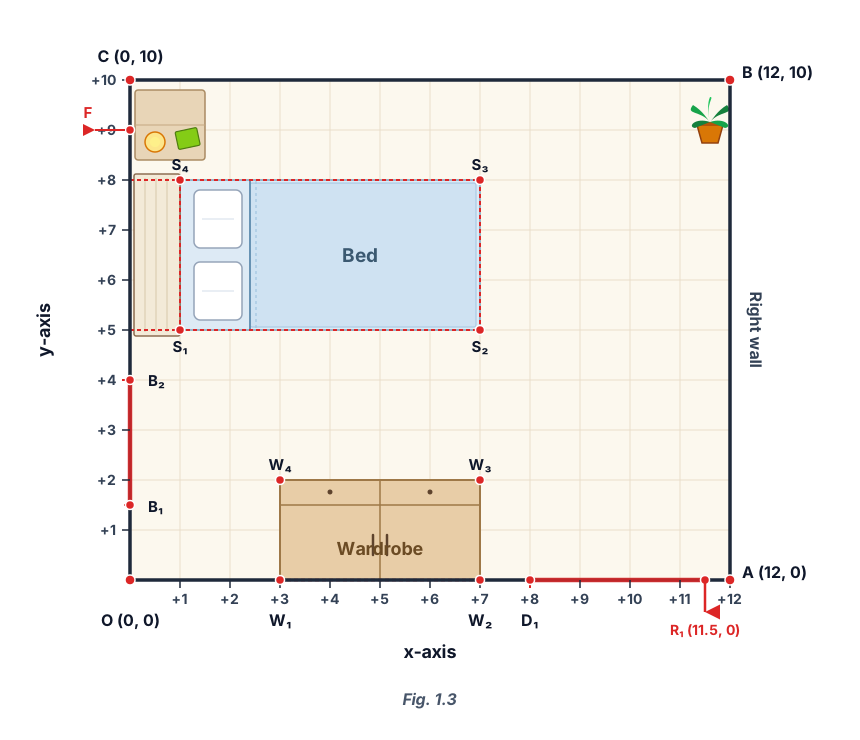
Fig. 1.3: Layout of Reiaan's Room with Coordinate AxesFig. 1.3
Fig. 1.3: Reiaan's room showing corners O(0,0), A(12,0), B(12,10), C(0,10), coordinate axes, wardrobe W₁W₂W₃W₄, bed S₁S₂S₃S₄, room door D₁R₁, and bathroom door B₁B₂

Fig. 1.3: Reiaan's room with corners OABC marking its corners, showing the x-axis, y-axis, wardrobe, bed, and door positions.

Solution
(i) Distance of the door from the left wall and the x-axis:

From Fig. 1.3:

•D₁ lies at x = 8 on the x-axis.
•The left wall of the room is the y-axis, where x = 0.
•The door lies on the x-axis.
Therefore, the distance of the door from the left wall is:

Distance from the left wall = 8 − 0 = 8 units

Since the door lies on the x-axis, its distance from the x-axis is:

Distance from the x-axis = 0 units
Therefore:

Distance from the left wall = 8 units

Distance from the x-axis = 0 units
(ii) Coordinates of D₁:

From Fig. 1.3, D₁ lies:

•8 units to the right of the y-axis
•on the x-axis
Therefore:
x = 8, y = 0
Hence:
D₁ = (8, 0)
(iii) Width of the room door and wheelchair accessibility:

From part (ii):

D₁ = (8, 0)

and we are given:

R₁ = (11.5, 0)

Since both points have the same y-coordinate, the width of the door is the difference between their x-coordinates:

Width of room door = 11.5 − 8
= 3.5 units
Therefore:
Width of room door = 3.5 units

From the scale used in the figure, this is:

3.5 ft = 3.5 × 12 inches = 42 inches

Therefore:
Width of room door = 3.5 ft

For a simple real-world comparison, a wheelchair is commonly around 2 to 2.25 ft (24 to 27 inches) wide. A doorway of 3.5 ft (42 inches) is therefore considerably wider than that.

So, a person using a wheelchair would have enough space to enter more easily.
Therefore, the 3.5 ft wide door provides enough space for easier wheelchair access.
(iv) Comparison of the bathroom door and room door:

The bathroom door lies along the y-axis.

Its two ends are:

B₁ = (0, 1.5)

and

B₂ = (0, 4)
Therefore, its width is:
Width of bathroom door = 4 − 1.5
= 2.5 units

From part (iii), the room door is:

3.5 units

Since:
2.5 < 3.5

the bathroom door is narrower.

Therefore, the bathroom door is narrower than the room door.
Answer:(i) Distance from the left wall = 8 units, Distance from the x-axis = 0 units | (ii) D₁ = (8, 0) | (iii) Room door width = 3.5 ft = 42 inches; provides enough space for easier wheelchair access | (iv) Bathroom door width = 2.5 units; the bathroom door is narrower than the room door

Need to practice other sections in Chapter 1?

Return to Chapter 1 (Orienting Yourself: The Use of Coordinates)→